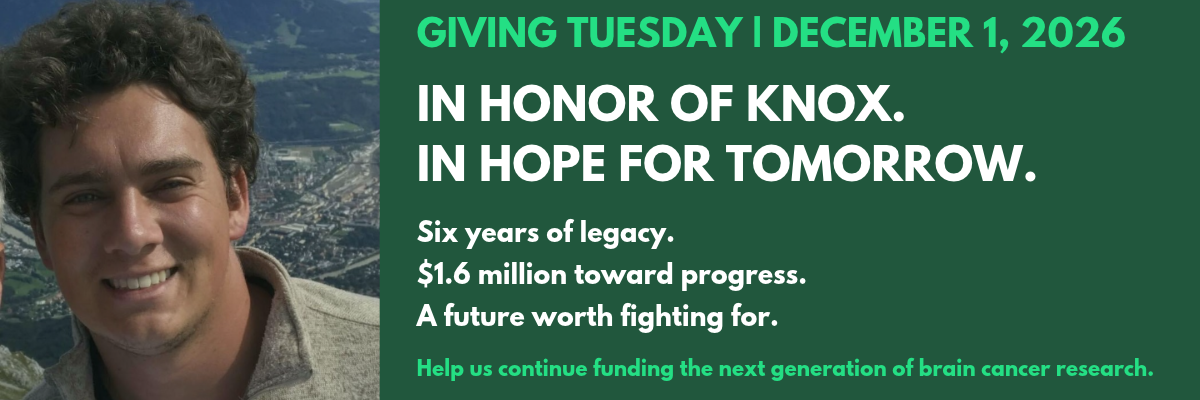
IN HONOR OF KNOX. IN HOPE FOR TOMORROW.
Six years of legacy. $1.6 million toward progress. A future worth fighting for.
GIVING TUESDAY | DECEMBER 1, 2026
This Giving Tuesday, December 1st, join us in honoring Knox Martin's legacy and helping move brain cancer research forward.
December 1st is a day that holds special meaning for the Knox Martin Foundation. Six years ago, on December 1, 2020, we lost Knox after his three-year battle with brain cancer.
What began with unimaginable heartbreak has grown into something extraordinary.
In the years since Knox's passing, his legacy has inspired a community of people determined to make a difference for others facing the same fight. Together, we've contributed $1.6 million to the Duke Brain Tumor Center since 2021 to support research and development focused on high-grade glioma and glioblastoma.
In 2026, that support has advanced six complementary research projects, exploring new treatment approaches, understanding why tumors return, and helping bring promising therapies closer to patients.
Six years after Knox’s passing, our reason for fighting remains the same.
We want warriors like Knox to have a shot at a long life. We want families to have more time together. And we want a future where a brain cancer diagnosis doesn't have to mean the send of someone’s story.
This December 1st, Giving Tuesday, we invite you to remember Knox, celebrate how far we've come, and help us continue the work ahead.
In honor of Knox. In hope for tomorrow. The next breakthrough starts with us.
Our 2026 Impact
KMF has given $1.6M to the Duke Brain Tumor Center to support research and development of high grade glioma and glioblastoma projects since 2021. Collectively, these projects show how the generosity of our donors fuels progress across the entire spectrum of brain tumor research—from discovery to direct patient impact.
In 2026, KMF support helped advance six complementary research projects at the Duke Brain Tumor Center. This work spanned studies of why tumors recur, how the immune system responds to treatment, and the development of innovative therapies.
FLiRT Trial – Repurposing Prozac to Treat Glioblastoma
In September 2026, initial results from the completed and closed trial were presented at the European Association of Neuro-Oncology scientific meeting. Early evidence suggests that fluoxetine disrupts how tumor cells process fats. Unexpectedly, the team also found that it may reduce the activity of immune cells that normally help protect tumors. Our team is now working to validate these observations to determine whether fluoxetine could improve the effectiveness of chemotherapy.
MOAB Trial – Understanding How Immunotherapy Changes Glioblastoma
KMF support continues to enable cutting-edge spatial analyses that map individual cells within tumor tissue and reveal how cancer cells and immune cells interact. Early findings are helping identify barriers to treatment and inform more effective immunotherapy combinations.
BRiTE and TRiTE – Developing Next-Generation Immunotherapies
BRiTE uses an engineered protein to connect immune cells directly to glioblastoma cells, and has already entered early clinical testing at Duke. Building on this work, our team is developing TRiTE, a more advanced version of the treatment, with potential early clinical trials opening in 2028.
REVAMP Trial – Advancing a New Glioblastoma Vaccine
The REVAMP trial is developing a therapeutic vaccine designed to train the immune system to recognize and attack glioblastoma cells. A generous donor contribution matched KMF's commitment, doubling the combined support from these two sources. REVAMP was also selected for rolling FDA review, potentially accelerating the path toward clinical testing!
GRETeL Study – Understanding Responses to Glioblastoma Treatment
Researchers have identified promising markers that may help predict treatment response and tumor progression. Most analyses are complete, and findings are being prepared for publication.
Oligodendroglioma Study – Understanding Patterns of Recurrence
Researchers are examining where, when, and how oligodendrogliomas return, sometimes many years after treatment. The goal is to improve monitoring and help physicians make better decisions about additional treatment.
Together, these six projects represent complementary approaches to improving brain tumor treatment. KMF's support has been instrumental in advancing this research, enabling sophisticated tumor analyses and helping move the REVAMP vaccine toward clinical testing. Continued KMF support will be critical both to sustaining progress across this research portfolio and advancing the REVAMP Trial toward its first patient enrollment.
With the help of our donors, we are truly advancing research on brain cancer to give warriors like Knox a shot at a long life! Please consider joining us in 2027 as we strive to continue funding this important and vital research at the Duke Brain Tumor Center